☞ 黃: 누를 황, 眞: 참 진, 伊: 저 이.
Like so many figures that have become legend, it is impossible to winnow fact from embellishment. At any rate, there are 6 or so verses each of 시조 and Chinese poetry 한시 attributed to her that still survive (the exact number depends on who is counting).
One of those verses is the following, which has an especially intriguing second line.
相思相見只憑夢, Thinking of each other and seeing each other, we only rely on dreams--
儂訪歡時歡訪儂. But when I go to visit my love, my love has come to visit me.
願使遙遙他夜夢, I want to send, across the distance, his night's dream,
一時同作路中逢. That we start at the same time and meet mid-way.
☞ 相: 서로 상, 思: 생각 사, 見: 볼 견, 只: 다만 지, 憑: 기댈 빙, 夢: 꿈 몽,
儂: 나 농, 訪: 찾을 방, 歡: 기뻐할 환 ※ According to the 《한어대자전》, this word was commonly used, along with 儂, in old Music Bureau style poetry as a form of address used between lovers, 時: 때 시,
願: 바랄 원, 使: 부릴 사, 遙: 멀 요, 他: 다를 타, 夜: 밤 야,
一: 한 일, 時: 때 시, 同: 한가지 동, 作: 지을 작, 路: 길 로, 中: 가운데 중, 逢: 만날 봉.
She keeps going to visit her love, but he is not home because he has gone to her house to see her. It's like the old-time version of telephone tag. The original line is also clever because of the way it mirrors around the word "when 時."
Here is another poem 황 is credited with, this one drafted at a farewell dinner.
月下梧桐盡, Under the moon, the paulownia exhausts [its leaves];
霜中野菊黃. In the frost, wild chrysanthemums yellow.
樓高天一尺, The loftbuilding is high: within a foot of heaven;
人醉酒千觴. People are rapt on a thousand goblets of wine.
流水和琴冷, The flowing water harmonizes with the coolness of the lute;
梅花入笛香. Apricot blossoms enter the fragrance of the flute.
明朝相別後, Tomorrow morning, after we part from each other,
情與碧波長. [My] emotion will be as long as the blue waves.
☞ 月: 달 월, 下: 아래 하, 梧: 오동 오, 桐: 오동 동, 盡: 다할 진,
霜: 서리 상, 野: 들 야, 菊: 국화 국, 樓: 누각 루, 高: 높을 고, 天: 하늘 천, 尺: 자 척,
人: 사람 인, 醉: 취할 취, 酒: 술 주, 千: 일천 천, 觴: 술잔 상,
流: 흐를 류, 水: 물 수, 和: 화할 화, 琴: 거문고 금, 冷: 찰 랭,
梅: 매화 매, 花: 꽃 화, 入: 들 입, 笛: 피리 적, 香: 향기 향,
明: 밝을 명, 朝: 아침 조, 別: 다를 별, 後: 뒤 후,
情: 뜻 정, 與: 더불 여, 碧: 푸를 벽, 波: 물결 파, 長: 길 장.
There is an interesting ambiguity in the second line. It is clear that the verse reads "In the frost, wild chrysanthemums 'yellow 黃,'" the question is what it means to "yellow." If we were talkig about a tree or another type of flower, this would be a pretty unamiguous "wither." The problem is that, since chrysanthemums are yellow when they are in bloom, it could also mean "bloom in a pretty shade of yellow." Indeed, you can find translators on both sides of the fence, with some saying "fade," while others say "bloom prettily."
I discovered that it may be okay to just sit solidly on the fence. Just say that it obviously refers to the situation where some chrysanthemums have already withered, while others are in bloom. Behold:
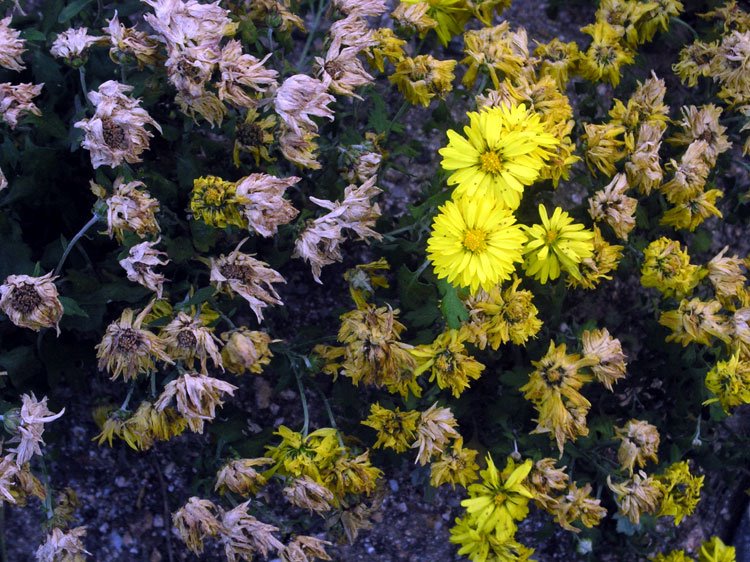
I fear that rendering this in English, however, is bound to yield a clumsy monster.
댓글 없음:
댓글 쓰기